Customizing Infrared Sauna Blankets: OEM Options for Controller, Logo, and Outer Fabrics
A logo alone rarely makes a sauna blanket feel like your product. The surface finish, closure, controller interface, instructions, and unboxing experience all shape how customers judge it. For a wellness brand, those choices can support a distinct position and a stronger price. The margin still depends on materials, tooling, order volume, freight, returns, and retail economics; customization does not guarantee a premium.
The right starting point is a product brief. Identify your buyer, target market, intended use, price band, initial volume, and the features that must be different. Then decide which details can be changed on an existing platform and which need engineering work. A custom sauna blanket manufacturer should be able to show the cost, sample, testing, and minimum-order implications of each choice before you approve production.
Aesthetic customization: material, color, finish, and logo
Choose the surface for use and cleaning
PU-coated outer materials offer a broad choice of color and texture. A matte black finish can hide reflections in product photography; a glossy finish creates a different visual impression but may show fingerprints more readily. Ask for physical swatches and a heated prototype. Judge color under normal indoor light, surface feel, odor after heating, sweat resistance, wipe-clean performance, seam appearance, and consistency between material lots. A swatch on its own does not show how the finished blanket will look when folded or zipped.
A custom PU color may require a material mill’s minimum order and a color-matching approval. Reusing an available color can reduce the initial commitment. Specify the color reference, acceptable visual tolerance, surface finish, backing, and any required material test evidence in the approved bill of materials. For an OEM line, these details matter as much as the headline color name.
Make branding durable without compromising the shell
Private label sauna blanket branding can use a printed logo, heat transfer, woven label, or another construction-compatible method. Embroidery can look premium on a carry bag or a separate patch. Direct embroidery through a coated, moisture-resistant blanket shell may create needle holes, so it needs a design review and a finished-product sealing test before approval. Contrast stitching can define the silhouette, but thread color, stitch density, seam strength, and cleanability should be checked on a real sample.
Keep the logo size and position practical. A mark that looks balanced on a flat design drawing can distort across a curved neckline or disappear when the blanket is in use. Ask for a full-size mockup and an approved production sample, not only a digital rendering. FITKANG’s sauna blanket range lists material, color, controller, logo, and packaging options; availability varies by model.
Hardware and engineering: build a controller around the user
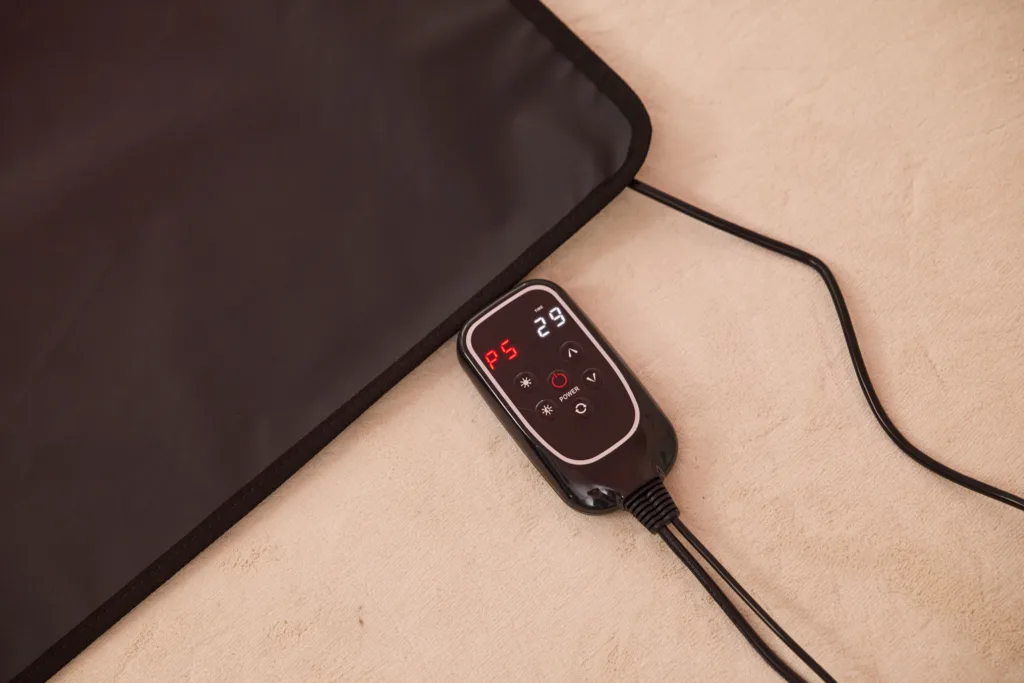
An OEM sauna blanket controller can start with a revised faceplate and button labels or extend to a new enclosure, display layout, and control logic. Define the user journey first: how a person starts a session, changes temperature, sets a timer, recognizes a fault, and shuts the unit down. For a spa, legible controls and repeatable settings may be more valuable than an elaborate screen animation. For a home product, clear instructions and simple feedback reduce support questions.
Separate interface changes from electronic redesign
A brand color or printed overlay may use an existing controller architecture. A new LCD splash screen requires a compatible display and firmware review. Custom timer limits, temperature set points, zone controls, or control-board and chip changes can affect sensors, overheat protection, electrical behavior, and market-specific testing. Do not assume that a cosmetic change and a firmware change have the same lead time or certification impact.
Write a controller specification covering display units, buttons, temperature range, timer steps, default state, error messages, shutoff behavior, cord and connector, rated voltage, and language. Ask the factory to demonstrate normal use and defined fault conditions on a working prototype. Freeze a software version and controller bill of materials before tooling or mass production; otherwise, two batches with the same appearance may behave differently.
Protect compatibility and serviceability
If you change the controller shape or functions, confirm the mating connector, cable strain relief, heating zones, sensor type, and replacement-part plan. Document whether a replacement controller will work with the first production batch. A custom enclosure may require a mold, while a new circuit board can require engineering validation and test fixtures. The design review should produce an approved sample, drawings, software version, test plan, and a clear list of who owns the tooling and design files.
Retail boxes and accessories: design for delivery as well as display
A customized infrared blanket can include a branded carrying bag, printed manual, care card, protective liner, and retail box. Keep the artwork aligned with the actual model, plug, voltage, warnings, and approved claims for each market. For a multilingual launch, allocate enough space for legible instructions instead of shrinking essential safety text to preserve the graphics.
Choose packaging for its journey. A display box may need an additional shipping carton and controller protection for direct-to-consumer parcels. If you want lower-plastic inner packaging, test a paper-based insert or molded pulp with the complete packed product. Confirm moisture protection, abrasion resistance, drop-test performance, packed dimensions, and recycling claims for the destination market. “Eco-friendly” is too broad to stand alone; specify the material and the claim you can substantiate.
For salon or spa buyers, coordinated logos, labels, manuals, and packaging can make multiple treatment rooms feel consistent. See how we tailor custom equipment for global partners in our Spas & Beauty Salons Solutions section.
Customization matrix for project planning
The lead-time sequence below is a planning guide, not a published FITKANG quotation. Tooling cost and MOQ depend on the model, component supplier, artwork, validation scope, and production schedule. Request written figures for your exact configuration.
| Customization level | Typical scope | Lead-time driver | Tooling fee and MOQ basis |
| Basic logo | Existing blanket with printed mark, label, or branded insert | Artwork proof and production sample; usually the shortest path | Printing or setup fee may apply; MOQ set by decoration method and base model |
| Material and packaging | Existing construction with selected PU color, finish, bag, manual, or retail box | Swatches, material sourcing, print proof, packed-product testing | Usually no new product mold; material and box supplier minimums may raise MOQ |
| Controller interface | Existing electronics with revised overlay, screen graphics, labels, or approved settings | Interface prototype, firmware review, functional and safety validation | Artwork or software charges may apply; MOQ depends on display, PCB, and controller supplier |
| Full tooling and engineering | New controller shell, circuit design, blanket structure, or heating configuration | Drawings, tooling, prototypes, test iterations, and market documentation; longest path | Quoted nonrecurring engineering and tooling; MOQ based on dedicated components and production run |
Ask the factory to quote sample lead time, approval steps, mass-production lead time, nonrecurring fees, MOQ, and unit price at both trial and reorder volumes. A “free mold” offer can still embed tooling cost in the unit price or restrict ownership. Put tooling ownership, storage, maintenance, and transfer rights in the contract.
Start with a design brief, then approve a real sample
Send the supplier your target market, preferred base model, reference colors, logo files, controller requirements, packaging concept, expected first order, and annual volume estimate. Ask for a feasibility review before commissioning detailed artwork. Use a mockup to compare options, then approve a physical pre-production sample with the exact materials, firmware, branding, and packaging that will be shipped.
FITKANG can discuss existing platforms and deeper OEM/ODM development for sauna blankets. Product developers, spa chains, and private label teams can request design mockups, prototype options, an itemized tooling and MOQ proposal, and a validation plan for their chosen configuration.
Have More Custom OEM or Technical Questions?
FITKANG provides turnkey contract manufacturing and custom engineering for global wellness brands. Talk with our team to request technical datasheets, sample terms, and volume pricing.

Leave a Reply