
Sauna Blanket Materials Guide: PU Leather, Bian Stones, and Gemstone Layers
The outer surface is the first thing a buyer sees, but the useful questions are underneath it: What touches the user? What keeps sweat away from the electrical parts? How does the heating layer bend, and how will the blanket clean up after repeated use? Material choice affects comfort, durability, heat distribution, and electrical safety. A premium-looking gemstone infrared blanket still needs sound wiring, insulation, temperature control, and test documentation. This guide explains what each layer can do—and what a materials list alone cannot prove.
Outer and Inner Linings: PU, PVC, and Skin Contact
PU is a material family, not a safety certificate
PU-coated fabric, often marketed as “PU leather,” gives many sauna blankets a smooth, flexible, wipe-clean surface. Formulations differ in backing fabric, coating thickness, additives, and finish. A well-specified PU can resist repeated folding and be pleasant to handle. It can also degrade if exposed to unsuitable cleaners or heat beyond its rated conditions. A non-toxic PU leather sauna blanket is a testable product claim, not something established by the letters “PU.” Ask for material composition, applicable restricted-substance results, and test conditions relevant to heated use.
PVC can provide a moisture-resistant barrier and is used in some inner layers. It is not automatically “cheap” or unsafe. Performance depends on formulation, plasticizers, thickness, seam construction, and how the layer is protected from direct skin contact. FITKANG’s product range lists flame-retardant PU, waterproof PVC, and wear-resistant nylon as options on selected models. The right comparison is between specified grades and finished assemblies, not between generic material names.
Odor, VOCs, and flame resistance
“Zero odor” and “zero VOC” are especially difficult promises. A new material can emit compounds at low levels even when it has little noticeable smell, and a pleasant smell does not prove safety. The U.S. Environmental Protection Agency cautions that “no VOC” and “low VOC” labels do not by themselves establish low indoor-air risk. Buyers should request an emissions or material-screening report that identifies the method, substances measured, detection limits, sample age, and temperature. A certificate for a raw sheet may not cover adhesives, inks, zipper tape, or the finished heated blanket.
Flame-retardant fabric or insulation can slow ignition or flame spread under a stated test. It does not make an electrical appliance fireproof. Ask which layer was tested, to which method, and whether the final assembly also passed its applicable electrical safety evaluation. For flexible appliances that heat the body, IEC 60335-2-17 describes relevant safety requirements; confirm the exact model and destination-market requirements.
Gemstone Layers: What Bian, Jade, and Germanium Add
Thermal mass and physical design
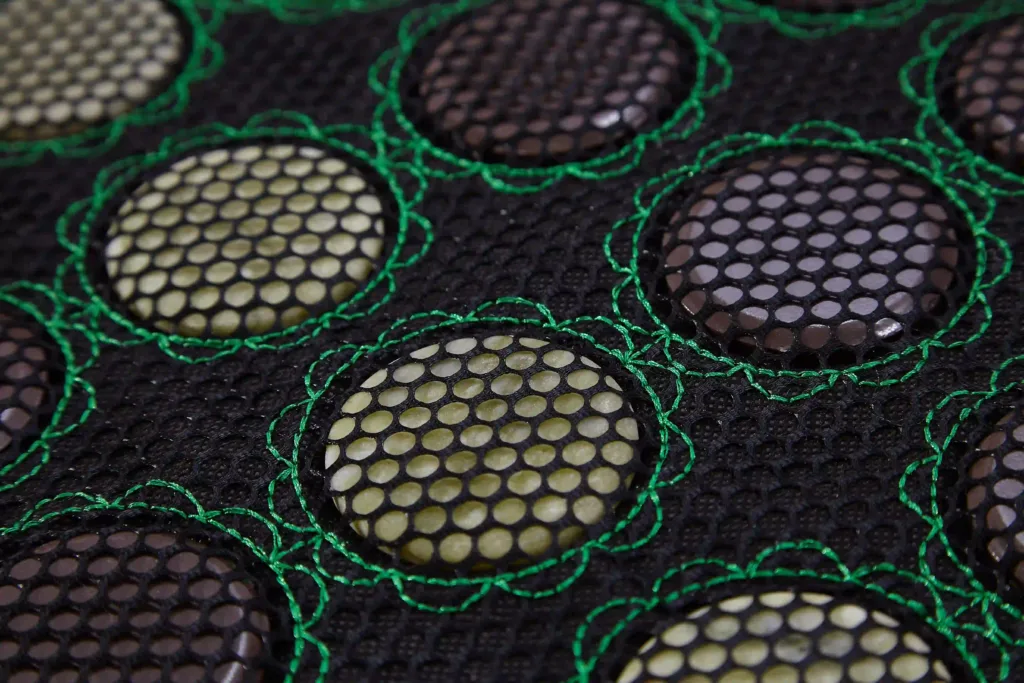
A Bian stone sauna blanket or jade sauna blanket may use stone pieces or inserts placed over or near a heating layer. Stones add thermal mass: once warmed, they can store some heat and release it as their temperature falls. Their size, spacing, mounting method, and backing layer influence weight, flexibility, local pressure, and cleaning. A thicker insert may feel more substantial but make the blanket harder to fold or pack. A stone layout must also leave a clear route for wiring and sensors.
FITKANG lists an S-105 three-zone model with black Bian stones, an S-103A with jade and germanium stones, and an S-107 with Bian and jade options. These are distinct configurations. Discover our specialized gemstone heating models in the 3 Zone Bian Stone Sauna Blanket. Confirm the exact stone count, placement, and surface construction for the model quoted to you.
Does a gemstone “boost” far-infrared efficacy?
Any warmed surface emits thermal radiation. Stone inserts may change local temperature, heat storage, and the radiation leaving the surface. The emission spectrum and total energy depend on the stone’s temperature and surface properties, as well as the heater underneath. A claim that jade, Bian stone, or germanium produces a clinically superior effect needs measured spectral output for the finished product and suitable human evidence. A generic gemstone description is not enough. Compare temperature maps, warm-up and cool-down data, and the user’s actual contact comfort before paying for a premium configuration.
The practical material advantages are often easier to assess: a stone pattern may create a different hand feel, visual identity, weight, and product tier. It can also introduce more attachment points to inspect. Ask whether the stones remain secure after folding, cleaning, and shipping, and how a damaged insert is repaired.
Heating, Insulation, and Moisture Barriers
The heating layer
Many infrared blankets use flexible carbon-fiber elements or engineered resistance conductors. The layout should distribute heat across the intended zones without sharp hot spots. A heating element’s advertised material does not prove uniformity; request a temperature map at defined settings and times. Bend and folding tests matter because a sauna blanket is repeatedly packed away. Buyers should also ask how the electrical connection is strain-relieved where the cable enters the textile assembly.
Insulation and waterproof protection
Thermal insulation helps direct warmth toward the user and protect the outer surface. Some designs use flame-retardant cotton or another insulating layer, but its grade and position should be confirmed in the build specification. Moisture-resistant films or coatings help separate sweat from live electrical parts. “Waterproof” should never be read as permission to immerse the product: seams, zippers, controller connectors, and cleaning procedures all matter. Disconnect power, allow the blanket to cool, wipe the user-facing surface as instructed, and let it dry before folding.
The complete stack must also work with temperature sensors and an overheat cutoff. A thicker stone or insulation layer can alter the temperature seen by a sensor relative to the temperature at the body-facing surface. That is why the final assembled model, not only its individual materials, needs functional and electrical checks.
Material Comparison for Buyers
| Material or layer | Durability question | Heat behavior | Cleaning consideration |
| PU-coated fabric | Check flex, abrasion, seam strength, and coating life | Flexible surface over the heater; depends on grade and thickness | Usually wipe-clean; verify approved cleaner |
| PVC barrier | Check formulation, plasticizer restrictions, and seam integrity | Moisture barrier; can affect insulation by thickness | Protect from punctures; never immerse assembly |
| Nylon outer fabric | Check abrasion resistance and coating | Structural cover rather than primary heater | Follow coating-specific cleaning instructions |
| Bian, jade, or germanium inserts | Check attachment and folding-cycle retention | Add thermal mass and local surface texture | Clean around inserts and seams thoroughly |
| Insulation and heating layer | Check flex cycles, hot spots, and cable strain relief | Governs heat spread and outer-surface protection | Keep moisture out of electrical connections |
Buyer’s Checklist
– Request a cross-section or bill of materials for the exact model, including every skin-facing layer, coating, adhesive, and stone attachment method.
– Ask for restricted-substance and emission reports relevant to the target market. Treat “zero VOC” as a claim requiring a defined test and detection limit.
– Compare surface-temperature maps, warm-up time, and overheat-protection behavior for both plain and gemstone versions.
– Check electrical safety, cord and controller ratings, moisture protection, and the cleaning instructions for the finished assembly.
– Inspect a sample after repeated folding and wiping. Look at coating cracks, seam edges, loose stones, and zipper or cable entry points.
Conclusion
Good sauna blanket materials are selected as a system. PU, PVC, nylon, insulation, carbon-fiber heating, and gemstone inserts each solve a different engineering problem; none substitutes for complete-product testing. FITKANG describes material selection, functional testing, and burn-in checks across its range. For a sourcing decision, request the current model-specific materials specification and supporting test reports, then compare a sample under your intended cleaning and use routine. Contact the FITKANG team to discuss the right construction, gemstone option, and OEM configuration for your market.
Have More Custom OEM or Technical Questions?
FITKANG provides turnkey contract manufacturing and custom engineering for global wellness brands. Talk with our team to request technical datasheets, sample terms, and volume pricing.

Leave a Reply