Red Light Therapy Benefits: How It Works, Uses & Safety
Red light therapy uses visible red and near-infrared light to deliver a controlled light dose to tissue. Depending on the device and protocol, research suggests potential benefits for the appearance of skin and for post-exercise muscle comfort. It is non-UV light, and it should not feel like a hot sauna session. The catch is that “red light therapy” is not a single standardized treatment. Wavelength, intensity at the body, exposure time, distance, and the area covered all matter. As these devices move from clinics into gyms, spas, and homes, those specifications are more useful than a long list of promised outcomes.
How Does Red Light Therapy Work?
Photobiomodulation, or PBM, exposes tissue to selected wavelengths of light at a controlled dose. In laboratory studies, red and near-infrared light can influence cellular signaling, including processes involving mitochondria and adenosine triphosphate (ATP), the molecule cells use for energy. Cytochrome c oxidase is one proposed light-responsive target, but it is not proven to be the only mechanism. A cellular effect in a lab does not guarantee a visible benefit from every consumer device. Mechanism review.
Two common LED specifications are 660 nm red light and 850 nm near-infrared light. Red light is readily absorbed in superficial tissue, making it common in skin-focused devices. Near-infrared light generally reaches farther into tissue under suitable conditions, which is why it appears in products intended for larger body areas. Penetration is not a fixed depth: skin pigmentation, tissue composition, LED output, distance, and contact all change the delivered dose. Neither wavelength should be described as reaching a specific joint or muscle in every user.
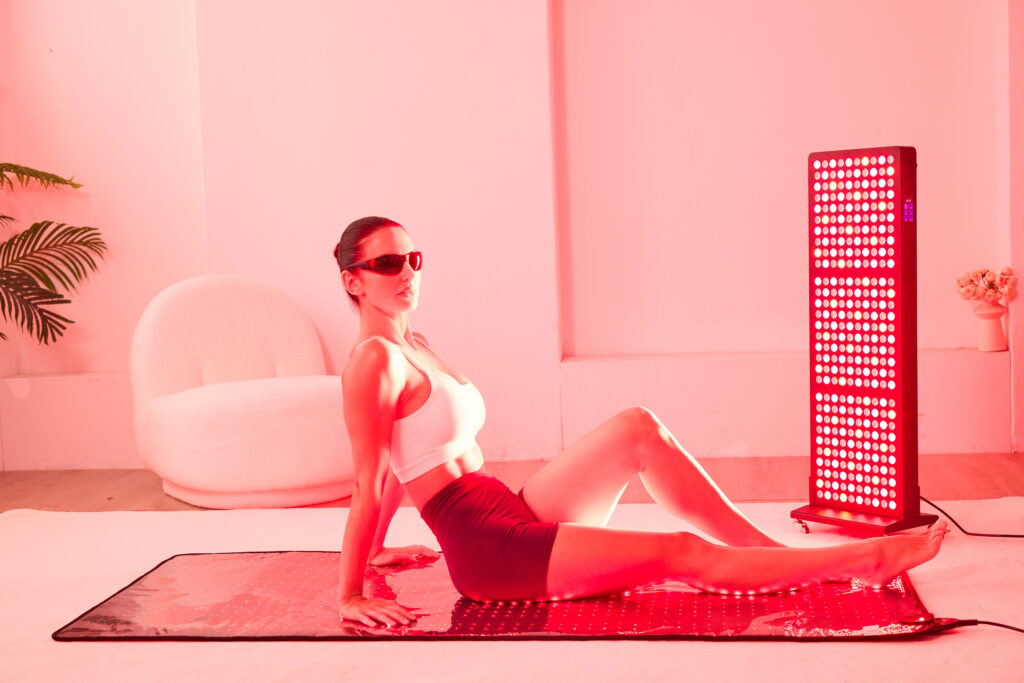
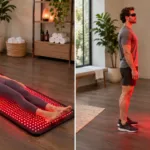
PBM is distinct from far-infrared sauna heating. An LED panel or mat delivers light; a sauna blanket primarily delivers heat. FITKANG’s range of professional red light therapy devices includes targeted belts, pads, full-body mats, and wraps.
5 Science-Backed Red Light Therapy Benefits
1. Skin Appearance and Rejuvenation
Skin appearance is among the better-studied cosmetic uses of PBM. Controlled studies of specific light devices have reported improvements in fine-line appearance or skin texture after repeated sessions. One sham-controlled trial of a 630 nm and 850 nm facial mask reported improved crow’s-feet scores over 16 weeks. That result is encouraging, but it does not establish the same outcome for every 660 nm panel, flexible mat, or session schedule. Facial-mask trial.
Some experiments suggest changes in collagen-related activity. For marketing, “may help improve the appearance of fine lines” is more defensible than promising a precise increase in collagen or elastin from an untested product. Clinics should distinguish a cosmetic service from a medical claim, and show customers what device, distance, and schedule were actually studied.
2. Post-Workout Muscle Recovery and Comfort
Athletes may use PBM as one part of a recovery routine. A systematic review of studies on delayed-onset muscle soreness reported favorable results for soreness and strength measures at certain follow-up points, but protocols varied and only a subset of studies could be pooled. That variability matters: a belt directed at a small muscle group is not the same exposure as a full-body mat. Systematic review.
A studio can reasonably describe a session as supporting post-workout comfort. It should avoid promising a particular recovery time or replacing rest, nutrition, progressive training, or professional assessment when pain is persistent. Businesses should record which device and settings they use so customer expectations stay tied to a repeatable service.
3. Joint Comfort and Everyday Mobility
An 850 nm LED may deliver light farther into tissue than a visible red LED under comparable conditions. That physical property does not prove that a consumer mat will reach a particular joint at an effective dose. Joint comfort depends on the anatomical area, body position, fabric or air gap, light output, and time. For general wellness copy, describe a targeted light session as an option for temporary comfort and relaxation, without claiming it treats arthritis or another condition.
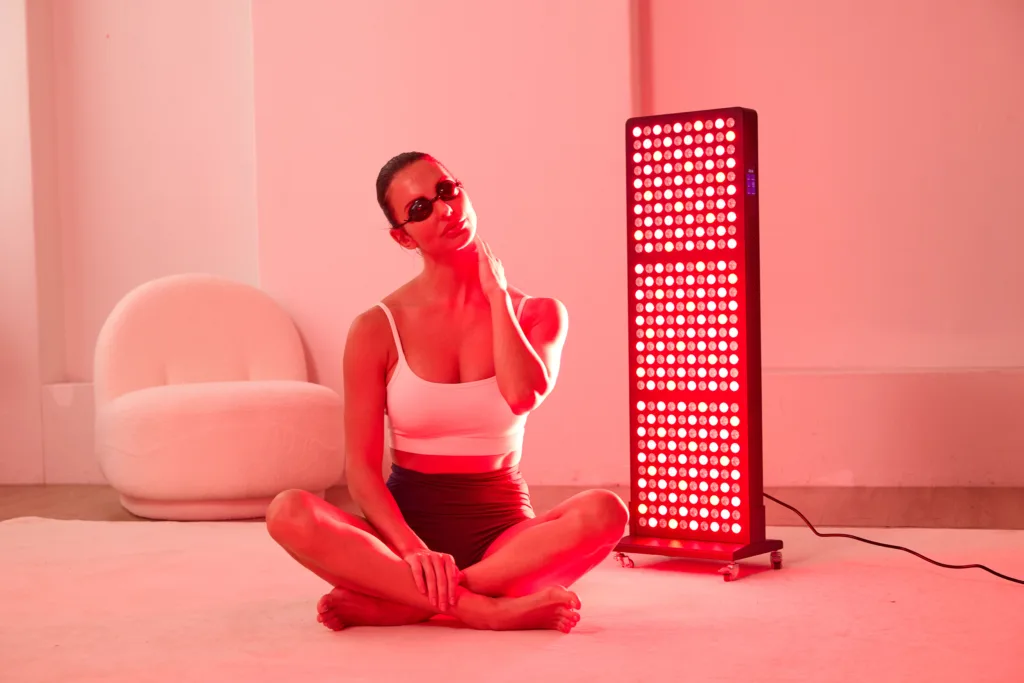
For buyers, wraps offer close fit, panels require a defined distance, and full-body mats cover a larger area. Ask for measured irradiance at the actual use position.
4. Scalp and Hair Appearance
Scalp-directed low-level light devices have been studied for hair-density outcomes, including in controlled trials of helmet-type devices. That evidence is specific to the device, light dose, target area, and study population. It should not be transferred to a body panel that happens to use the same wavelength. Controlled helmet-device trial.
For a cap or scalp device, request its wavelengths, emitter layout, instructions, and evidence. “Supports a fuller-looking appearance” is more suitable for general wellness copy than guaranteeing new hair growth.
5. An Evening Wind-Down Routine
A brief session may provide a quiet pause before bed, especially when it replaces time spent scrolling through a bright screen. Red light has a different spectral profile from blue-rich screen light, but that does not establish that a therapy device increases melatonin or improves sleep for everyone. Sleep outcomes depend on room lighting, timing, brightness, personal routine, and the device used. Treat evening relaxation as a user experience, not a guaranteed physiological effect.
For a home routine, choose a comfortable setting and turn the device off before sleep. For a studio, avoid selling a fixed “sleep protocol” unless it is supported by evidence for the specific device and exposure schedule.
Common Uses: Home Routines and Commercial Studios
Form factor changes the workflow. A flexible belt or wrap can place LEDs close to a selected body area. A facial mask or cap is designed around a specific shape and distance. A panel can serve several areas, but the user must maintain the prescribed distance and position. A full-body mat covers a wide area while the client lies down; cleaning and turnover become more important in a shared setting.
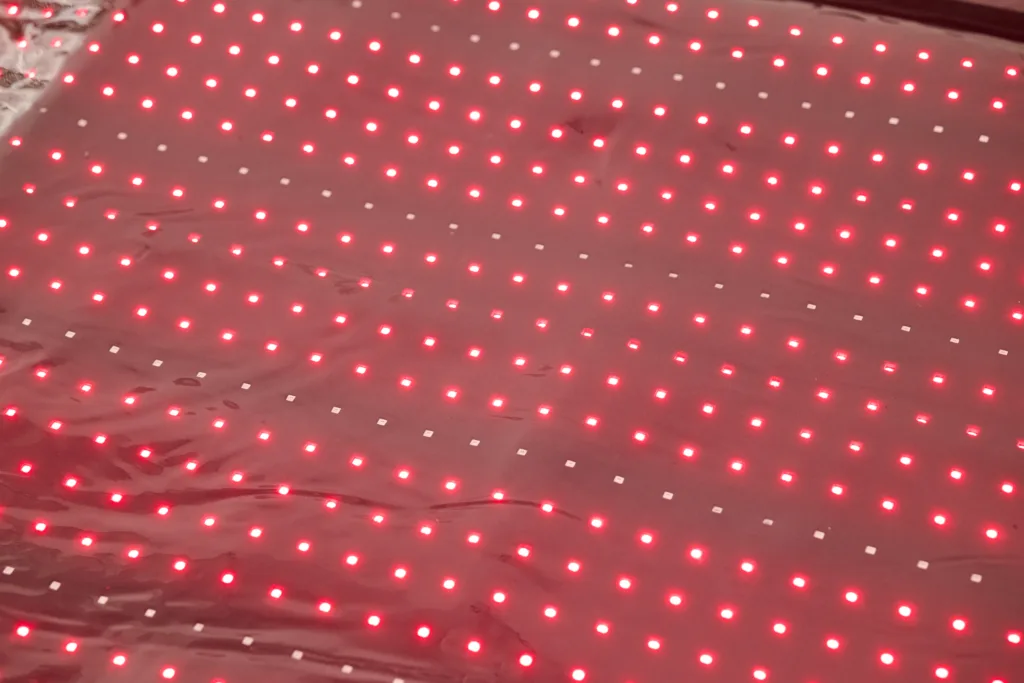
At home, easy setup supports consistent use. In a spa, staff need procedures for positioning, timing, eye protection, and cleaning. Distributors should compare power supplies, plugs, parts, and instructions. LED count alone does not tell a buyer the irradiance delivered to skin.
Safety, Side Effects, and What to Look for in a Quality Device
Red and near-infrared LEDs do not emit ultraviolet light when specified as such, and PBM is generally well tolerated when used as directed. Mild, temporary redness has been reported in some skin studies. Bright LEDs can be uncomfortable to look at; users should follow the manufacturer’s eye-protection guidance and avoid staring into the emitters. A device that also includes far-infrared heating has separate heat-related risks and instructions. Safety review.
People who are pregnant, use photosensitizing medicines, have an active skin condition, or have a condition that makes light exposure a concern should ask a qualified clinician before use. A business should avoid applying a general protocol to every client. Its screening and informed-use instructions need to match the device and intended service.
For a B2B purchase, request more than a wavelength printed on a carton:
- Verified wavelengths: Ask for spectral measurements of the shipped configuration. A 660 nm and 850 nm label should match the LEDs used in that model.
- Irradiance at use distance: Request mW/cm² measurements across the treatment area, with measurement distance and method stated. Energy delivered also depends on time; more intensity or longer exposure is not automatically better.
- Electrical and optical safety: Review power-supply ratings, controller behavior, operating limits, eye guidance, and applicable market documents for the exact model.
- EMF and flicker: If “low EMF” or “flicker-free” is advertised, ask for test conditions and measured values. Do not treat either phrase as a universal guarantee.
- Materials and service life: Check skin-contact fabric, cleaning compatibility, flexible-circuit durability, cable strain relief, replaceable parts, and warranty terms.
FITKANG lists red light belts, pads, caps, full-body mats, wraps, and panels, with 660 nm and 850 nm available across core flexible products. To compare the right format and current specifications, explore our range of red light therapy products and request the exact model’s technical sheet and test documents before approving a sample.
Frequently Asked Questions About Red Light Therapy
Can you use red LED light every day?
Some device protocols involve daily or several-times-weekly sessions, but frequency should follow the exact product’s instructions and the intended use. More sessions are not necessarily more effective. If a device causes persistent irritation or discomfort, stop and seek appropriate advice. Commercial operators should use one documented protocol per device rather than assuming every panel, mask, and mat is interchangeable.
Is 10 minutes of red light therapy enough?
It might be, but time alone cannot answer the question. A ten-minute session at one measured irradiance delivers a different light dose from ten minutes with another device or at a greater distance. The relevant variables are irradiance at the body, exposed area, time, and the outcome being sought. Use the manufacturer’s tested protocol; “10–20 minutes is enough for everyone” is not a reliable universal rule.
Is it good to sleep with red light on?
Use a device as an awake, timed session and switch it off before falling asleep unless its instructions explicitly allow overnight operation. An evening session can be part of a calming routine, but there is not enough device-specific evidence to promise better sleep or melatonin changes. A dark, comfortable sleeping environment remains a sensible default.
Bringing Reliable Red Light Therapy to Your Routine or Business
The most useful red light therapy benefits are linked to a defined device and repeatable exposure. Skin and recovery research provides context; scalp and sleep claims require careful matching between studies and products. Compare measured output, instructions, durability, and documentation before making marketing claims.
FITKANG can help buyers review current product specifications, wholesale options, and OEM/ODM choices for belts, pads, mats, wraps, caps, and panels. Share the target market, intended use, and required form factor to request a technical proposal grounded in the actual device configuration.
Have More Custom OEM or Technical Questions?
FITKANG provides turnkey contract manufacturing and custom engineering for global wellness brands. Talk with our team to request technical datasheets, sample terms, and volume pricing.
Leave a Reply